
For the entirety of modern medical history, psychiatry and gastroenterology have operated as entirely separate disciplines. A patient suffering from clinical depression, chronic anxiety, or severe brain fog was treated almost exclusively from the neck up. Treatment protocols focused heavily on altering brain chemistry through pharmacology. Today, a silent revolution taking place in cutting-edge research laboratories is entirely upending this paradigm. Scientists have discovered that the master key to human mental health may not lie inside the skull, but deep within the digestive tract.
This extensive report examines the "Gut-Brain Axis," exploring how the trillions of microorganisms inhabiting our intestines dictate our mood, govern our stress responses, and represent the most promising new frontier in treating psychiatric disorders.
Mapping the Gut-Brain Axis: The Vagus Nerve Superhighway
The human digestive tract is home to an unimaginably complex ecosystem known as the gut microbiome. It consists of roughly 39 trillion bacteria, fungi, and viruses. To put this in perspective, human bodies contain more microbial cells than actual human cells. Far from being passive passengers that merely assist in breaking down food, these microbes are highly active biochemical factories.
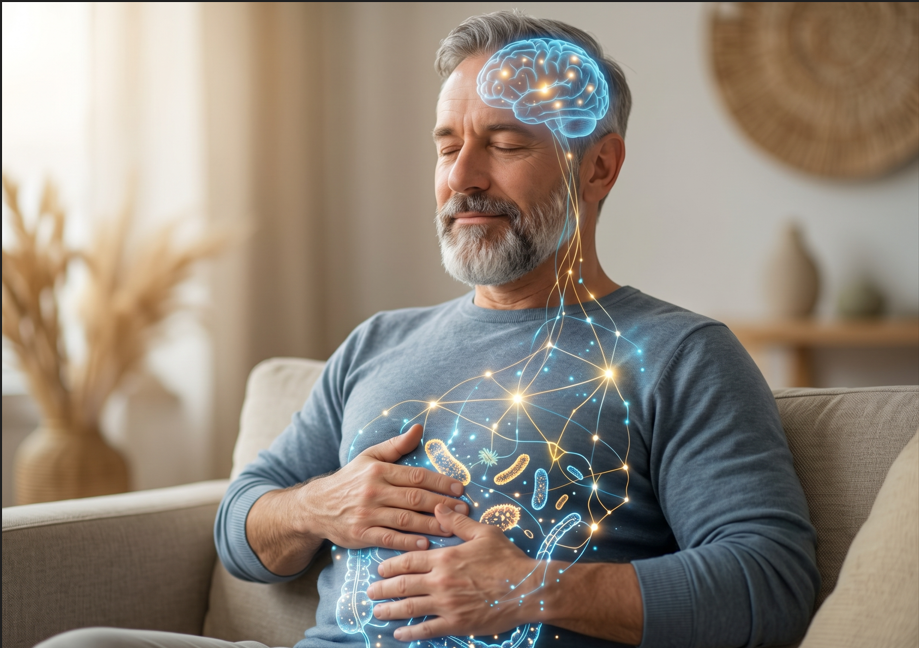
The communication between the gut and the brain is continuous, bi-directional, and remarkably fast. This communication network is known as the Gut-Brain Axis.
The physical bridge of this axis is the vagus nerve, the longest cranial nerve in the body, wandering from the brainstem all the way down to the abdomen. For a long time, scientists assumed the brain was doing the talking, sending commands down to the gut. Recent mapping of the vagus nerve reveals a staggering reality: approximately 80% to 90% of the nerve fibers are afferent, meaning they carry information from the gut to the brain. The microbes in our intestines are constantly sending biochemical signals, effectively dictating terms to our central nervous system.
Furthermore, the gut is wrapped in its own complex neural network called the Enteric Nervous System (ENS). Containing over 100 million neurons—more than either the spinal cord or the peripheral nervous system—the ENS is so sophisticated that researchers universally refer to it as the "Second Brain."
The Serotonin Factory: Why Happiness is Synthesized in the Gut
The most profound paradigm shift in modern neuroscience has been the re-localization of neurotransmitter production. Neurotransmitters are the chemical messengers that regulate mood, sleep, appetite, and emotional stability.
Serotonin, frequently referred to as the "happiness molecule," is heavily targeted by standard antidepressant medications (SSRIs). Astonishingly, an estimated 90% to 95% of the body's total serotonin is manufactured in the gastrointestinal tract. Specific strains of gut bacteria stimulate the enterochromaffin cells lining the gut to produce serotonin.
Additionally, gut bacteria produce other critical neurotransmitters, including:
- GABA (Gamma-aminobutyric acid): The brain's primary inhibitory neurotransmitter, responsible for calming the nervous system and mitigating anxiety.
- Dopamine: Crucial for motivation, reward, and pleasure. Nearly 50% of dopamine is synthesized in the gut.
When the microbiome is impoverished or imbalanced, the production line for these essential mood-regulating chemicals shuts down. The brain is effectively starved of the raw materials it needs to maintain psychological equilibrium.
Dysbiosis and Neuroinflammation: The Root of Modern Anxiety
An unbalanced gut microbiome is clinically referred to as dysbiosis. In the US and Australia, the standard Western diet—characterized by ultra-processed foods, high refined sugars, and a severe lack of dietary fiber—acts as an accelerant for dysbiosis.
When beneficial bacteria are starved of fiber, aggressive, pathogenic bacteria proliferate. This imbalance compromises the integrity of the gut lining, a single layer of cells responsible for keeping digested food and microbes inside the intestine. When this lining degrades, a condition known as "Leaky Gut" (intestinal permeability) occurs.
Microbial toxins, such as lipopolysaccharides (LPS), leak into the bloodstream. The body's immune system detects these foreign invaders and launches an aggressive, systemic inflammatory response.
Crucially, this inflammation does not stay localized in the body; it crosses the blood-brain barrier. Harvard Medical School researchers have identified neuroinflammation—inflammation of the brain tissue—as a leading driver of treatment-resistant depression, severe anxiety disorders, and cognitive decline. The brain fog and lethargy often associated with depression are now understood by many researchers to be an immune response to a leaking, inflamed gut.
The Assault on the Ecosystem: Modern Triggers
Maintaining microbial diversity is the hallmark of a healthy gut. However, modern lifestyles are uniquely hostile to this delicate ecosystem. The primary culprits driving the current epidemic of dysbiosis include:
- Ultra-Processed Foods & Emulsifiers: Chemical additives used to prolong shelf life and improve texture (like polysorbate 80 and carboxymethylcellulose) have been shown in laboratory settings to directly strip away the protective mucosal layer of the intestine, leading to immediate inflammation.
- Antibiotic Overuse: While life-saving, broad-spectrum antibiotics do not discriminate. They wipe out massive populations of beneficial microbes alongside pathogens, often leaving the gut landscape barren and susceptible to overgrowth by opportunistic fungi and resistant bacteria.
- Chronic Stress: The Gut-Brain Axis is bi-directional. Severe psychological stress sends signals down the vagus nerve that actually alter the gut environment, making it hospitable to pathogenic bacteria and hostile to beneficial ones, creating a devastating feedback loop of stress and dysbiosis.
Psychobiotics: The Next Frontier of Nutritional Psychiatry
The profound implications of this research have birthed an entirely new medical discipline: Nutritional Psychiatry. Clinicians are increasingly looking to manipulate the microbiome as a primary intervention for mental health, exploring a new class of treatments known as psychobiotics—targeted strains of live bacteria (probiotics) and the specific fibers that feed them (prebiotics) designed to yield specific psychiatric benefits.
To cultivate a resilient microbiome and fortify the "second brain," experts advocate for foundational dietary shifts:
- Radical Fiber Diversity: The goal is not just more fiber, but diverse sources of it. Different bacterial strains require different types of plant fibers (prebiotics) to thrive. Researchers recommend consuming 30 different types of plants (vegetables, seeds, nuts, legumes) per week.
- Living Foods: Reintroducing ancient preservation methods to the modern diet. Fermented foods like unpasteurized sauerkraut, kimchi, kefir, and traditional kombucha introduce diverse, living cultures directly into the digestive tract, actively repopulating the ecosystem.
- Polyphenol Consumption: Dark berries, high-quality cacao, and green tea are rich in polyphenols—compounds that human cells cannot digest, but which serve as powerful fuel for beneficial gut bacteria.
As clinical trials continue to yield astonishing results, the separation between physical and mental health is evaporating. The science is unequivocal: we are not solitary organisms, but complex superorganisms. The future of treating the human mind relies unequivocally on tending to the microscopic ecosystem residing in the human gut.
Scientific References
- Cryan, J. F., & Dinan, T. G. (2012). Mind-altering microorganisms: the impact of the gut microbiota on brain and behaviour. Nature Reviews Neuroscience, 13(10), 701–712.
- Mayer, E. A., Knight, R., Mazmanian, S. K., Cryan, J. F., & Tillisch, K. (2014). Gut microbes and the brain: paradigm shift in neuroscience. The Journal of Neuroscience, 34(46), 15490–15496.
- Bercik, P., et al. (2011). The intestinal microbiota affect central levels of brain-derived neurotropic factor and behavior in mice. Gastroenterology, 141(2), 599–609.
- Yano, J. M., et al. (2015). Indigenous bacteria from the gut microbiota regulate host serotonin biosynthesis. Cell, 161(2), 264–276.
- Rook, G. A. (2013). Regulation of the immune system by biodiversity from natural environments: an ecosystem service essential to health. Proceedings of the National Academy of Sciences, 110(46), 18360–18367.